
Chip Seal for Ranch and Private Roads Around Houston
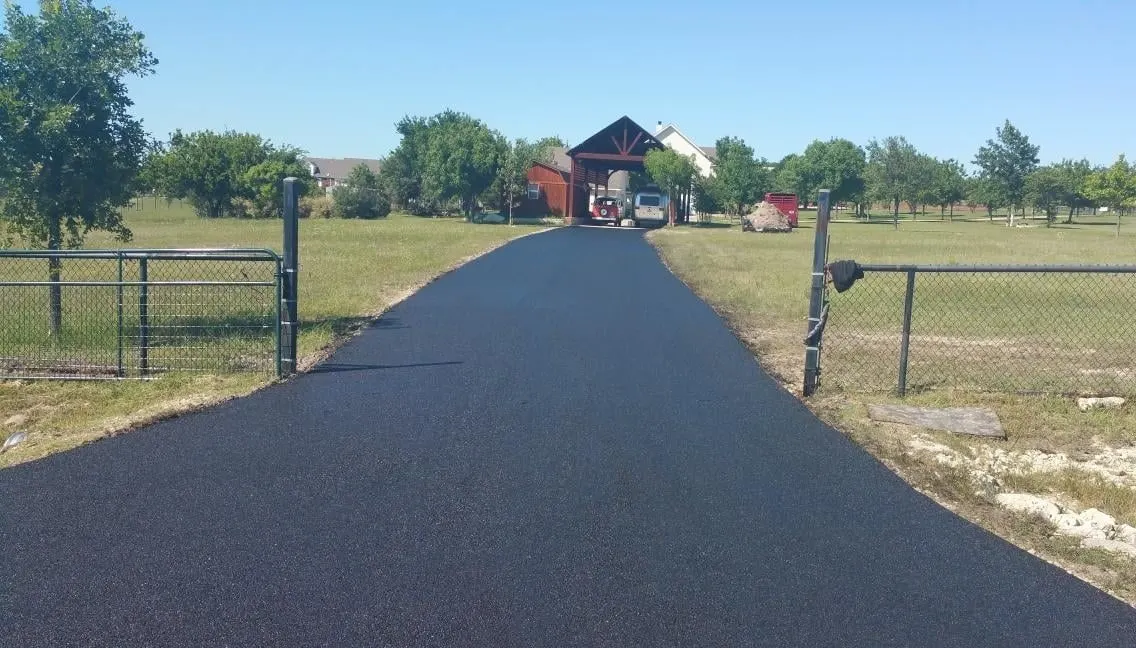
Chip seal works well on ranch roads, private roads and long acreage drives around Houston when the base underneath is firm and water has a way off the road. It is a layer of liquid asphalt binder with crushed stone pressed into it, so it protects a good road more than it fixes a bad one. We do this work across South and Southeast Texas, and the prep decides how it turns out.
Where chip seal fits on ranch and private roads
Chip seal, also called tar and chip, suits a lot of rural jobs. It can cover a short driveway to a house or a long private road that runs past pastures, a pond or a barn. If you are weighing it for a longer run, our chip seal paving page explains how the surface is built.
Before you choose a surface, look at two things: the road you already have and how it gets used. A road that sees pickups and a few deliveries asks less of a surface than one that carries loaded feed trucks, horse trailers or hay haulers every week. Heavy, frequent loads call for a stronger base, and sometimes a different surface altogether.
If your road is a working ranch road with gates, cattle guards and equipment crossings, our ranch road paving page covers that type of job. For a home driveway on private land, see private driveway paving.
Check the base, crown and drainage
Start with what is under the surface. The base is the stone or soil packed down beneath the road, and it carries every load that rolls over it. Chip seal is only a thin skin, so it copies the shape of whatever sits below. A soft spot, rut or pothole left unrepaired will show up again through the new surface.
Next, look at the crown, the high line down the middle of the road that sends water off to both sides. A flat or sunken center holds water, and standing water wears out both the base and the surface. Walk the road after a hard rain and mark every place where water sits.
Then find the culverts. These pipes carry water under the road at low spots and ditch crossings, so check each one before any paving starts.
- Is the culvert pipe open, or packed with silt and debris?
- Does water enter and exit freely, or does it back up?
- Is the road over the pipe sagging or cracked?
- Do side ditches carry water away from the road edge?
A chip seal surface does not correct a weak or soft base. If you find soft areas, they need to be dug out, rebuilt and compacted, or the money spent on the surface is at risk.
What the road condition tells you
| What you see | What it usually means | What to do first |
|---|---|---|
| Firm, even road with a visible crown | Base is likely sound | Light prep, then chip seal |
| Washboard or scattered potholes | Surface stone has thinned or loosened | Regrade and recompact before sealing |
| Ruts that hold water | Crown is lost or the base has pushed down | Rebuild the crown and fix drainage |
| Soft, pumping areas after rain | Weak base or water under the road | Repair the base and check culverts |
Plan around Houston area weather
Gulf Coast summers usually run long, hot and humid, and the area can see heavy rain from tropical systems into the fall. Winters across South and Southeast Texas are often mild, but rain in November and December can still interrupt surface prep and slow the binder cure. Binder is the liquid asphalt that holds the stone, and it needs suitable conditions to set. Wet ground and wet stone work against it.
That is why scheduling matters. A crew may wait for a dry window, and a road with poor drainage can take longer to dry out and be ready. Ask how the crew plans to sequence the work, and what happens if rain moves in partway through.
Access is part of the schedule too. Once the road is sealed, it needs time before vehicles drive on it, and many crews wait 24 to 48 hours or more depending on conditions. If your road is the only way in or out, plan where to park and how deliveries will reach you.
How your property changes the answer
Conditions vary a lot from one property to the next. If your road crosses clay soil, it may stay soft and slick after rain longer than a sandier road. If it climbs or drops toward the county road, water will run along it instead of off it. If it runs through timber, shade can slow drying.
We work with property owners in Houston, Cleveland and Livingston, and also in places like Magnolia, Conroe and Montgomery. If you are near Houston, a longer acreage drive may be the norm. Owners around Cleveland and Livingston may deal with long private roads shared by neighbors. In each case, check your own ground rather than assuming it matches the next lot over.
What to gather before requesting an estimate
A few notes up front make the site review faster and the estimate more accurate.
- Road length and width, even a rough pace count.
- The kind of traffic: cars, trucks, trailers, equipment or school buses.
- Gates, cattle guards and any tight turns.
- Every drainage crossing, culvert and spot where water sits.
- Soft areas, potholes and places where the road has washed out.
Ask for an assessment of the base, crown and any soft areas, not just a price for the surface. Cost depends on length, width, how much base repair is needed and how easy the site is to reach, so two roads of the same length can price very differently.
We offer a Free Estimate, and a site review is the surest way to learn what your road needs before any stone goes down.
Common questions
Can you chip seal an existing gravel ranch road?
Often yes, if the gravel base is firm, compacted and has a good crown. Soft or rutted sections usually need to be repaired first.
Is tar and chip a good option for a long acreage driveway?
It can be, because it covers long distances and gives a sealed surface. The base and drainage along the full length still decide how well it holds up.
Does chip seal work for private roads shared by several owners?
It can, as long as the road base can handle the traffic and the owners agree on drainage and access during the work. Walk the road together and note problem spots before asking for an estimate.
Topics
Areas we serve
Our services
Have a question about your project? Call (361) 645-7270